
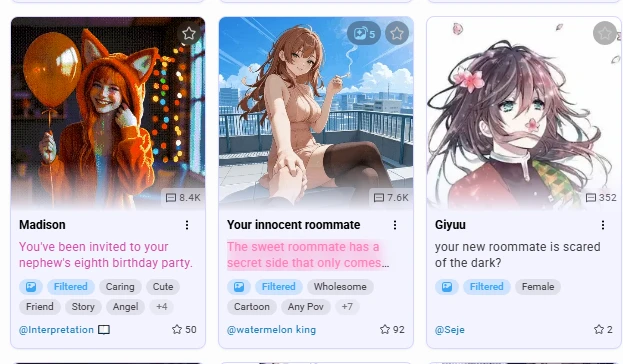
About 90% of AI character platforms offer some form of free access, but the experience varies widely. Most free plans include text conversations, public characters, and basic customization, while paid plans unlock larger AI models, longer memory, faster replies, voice, and image generation. Monthly subscriptions usually range from $9.99 to $39.99. Before choosing a platform, compare message limits, model quality, privacy rules, and licensing instead of assuming every free AI character service offers the same experience.
Many websites advertise free AI characters, but "free" can describe several different pricing models. Some platforms allow unlimited conversations with a basic language model, while others provide 20 to 100 messages per day before asking users to upgrade. During 2024 and 2025, the number of AI companion services increased rapidly, and many adopted a freemium model because cloud computing costs continue to rise as larger language models require more GPU resources.
That pricing model affects what users receive after creating an account. A free account usually includes public characters, text conversations, and simple profile editing. Premium plans often add larger context windows, better memory, faster response queues, and higher daily limits. Some services also include voice conversations, image generation, or multiple-character chats that are unavailable on free plans.
| Feature | Free Plan | Paid Plan |
|---|---|---|
| Text chat | Yes | Yes |
| Custom characters | Yes | Yes |
| Daily messages | Usually limited | Often unlimited |
| Long-term memory | Limited | Extended |
| Voice chat | Sometimes | Usually included |
| Image generation | Limited | Higher limits |
| Response speed | Standard | Priority |
The difference becomes more noticeable during longer conversations. A free AI character may remember only recent messages, while premium models can keep track of much more context. When a roleplay session reaches several thousand words, stronger memory reduces repeated explanations and keeps conversations more consistent. Several commercial models now support context windows exceeding 100,000 tokens, although availability depends on the subscription level.
Conversation quality is also influenced by the AI model itself. Entry-level models are designed to reduce computing costs and serve large numbers of users at the same time. Premium subscribers are often given access to newer models with better reasoning, improved instruction following, and more natural dialogue. Independent benchmark results published throughout 2025 showed measurable improvements in coding, writing, and multi-step reasoning as newer model generations became available.
A platform advertising "free AI characters" may still place limits on model selection, conversation length, or processing priority. Reading the pricing page usually provides a clearer picture than the homepage banner.
Many users also want to build their own characters. Most platforms allow this without charging a fee. Users can write a biography, personality description, greeting message, speaking style, interests, and background information. Some editors allow several thousand characters of configuration text, while others support structured prompts that define behavior in more detail. Premium plans may increase those limits or provide persistent memory that continues across future conversations.
Privacy is another area worth comparing before choosing a service. Some companies allow users to delete conversation history at any time, while others retain logs for quality improvement or safety review. Privacy policies also explain whether conversations may be reviewed by human moderators, how long information is stored, and whether users can export or remove their data. These details differ across platforms even when both advertise free access.
Some people also search for character platforms designed for mature conversations. In that category, ai nsfw services often have different moderation rules, age requirements, and subscription options than general-purpose chatbot platforms. Users should always review the platform's policies before creating an account because available features and content restrictions are not identical across providers.
Licensing is another topic that receives less attention. Some companies allow users to publish AI-generated stories, game dialogue, or marketing content commercially, while others restrict commercial redistribution or require attribution. Developers building products around AI characters should review the terms of service before integrating generated content into applications, websites, or digital products.
Another option is running an open-source language model locally. There is usually no monthly subscription, but hardware requirements can be significant. Models with 7 billion to 13 billion parameters may require 16 GB to 32 GB of system memory for comfortable operation, while larger models often benefit from dedicated GPUs with substantial VRAM. Electricity, storage, and hardware upgrades become part of the overall cost even though software licenses may be free.
Different users also experience free plans differently. Someone who exchanges 30 messages per day may never reach usage limits, while another user writing long stories or interactive roleplay sessions may hit restrictions within an hour. Students, casual users, language learners, and first-time visitors often find free plans sufficient for everyday conversations, while writers, developers, and creators working with AI every day usually benefit from higher limits and stronger models.
Instead of asking whether AI characters are free, compare several practical details before signing up:
-
Daily or monthly message limits
-
AI model available in the free plan
-
Memory length
-
Response speed
-
Character customization options
-
Voice and image support
-
Data privacy policy
-
Commercial usage permissions
Looking at these items provides a more accurate comparison than focusing only on the subscription price. Two services may both advertise free AI characters, yet one could include unlimited conversations with a smaller model while another limits daily messages but provides access to a more capable model. Spending a few minutes comparing these differences usually leads to a better experience and avoids unexpected upgrade decisions later.