
A first call with an ODM fragrance partner usually lasts half an hour and produces one of two outcomes: a useful scoping conversation with a proposal attached, or a friendly exchange that ends with a request to send more information. The difference is preparation. Six items turn the second outcome into the first: the format and how it is applied, the intended user, a volume estimate, the market, a reference direction for the scent, and a list of what the brand will supply itself. None of them has to be perfect, and saying that something is undecided is a valid answer — as long as you know which parts are undecided.
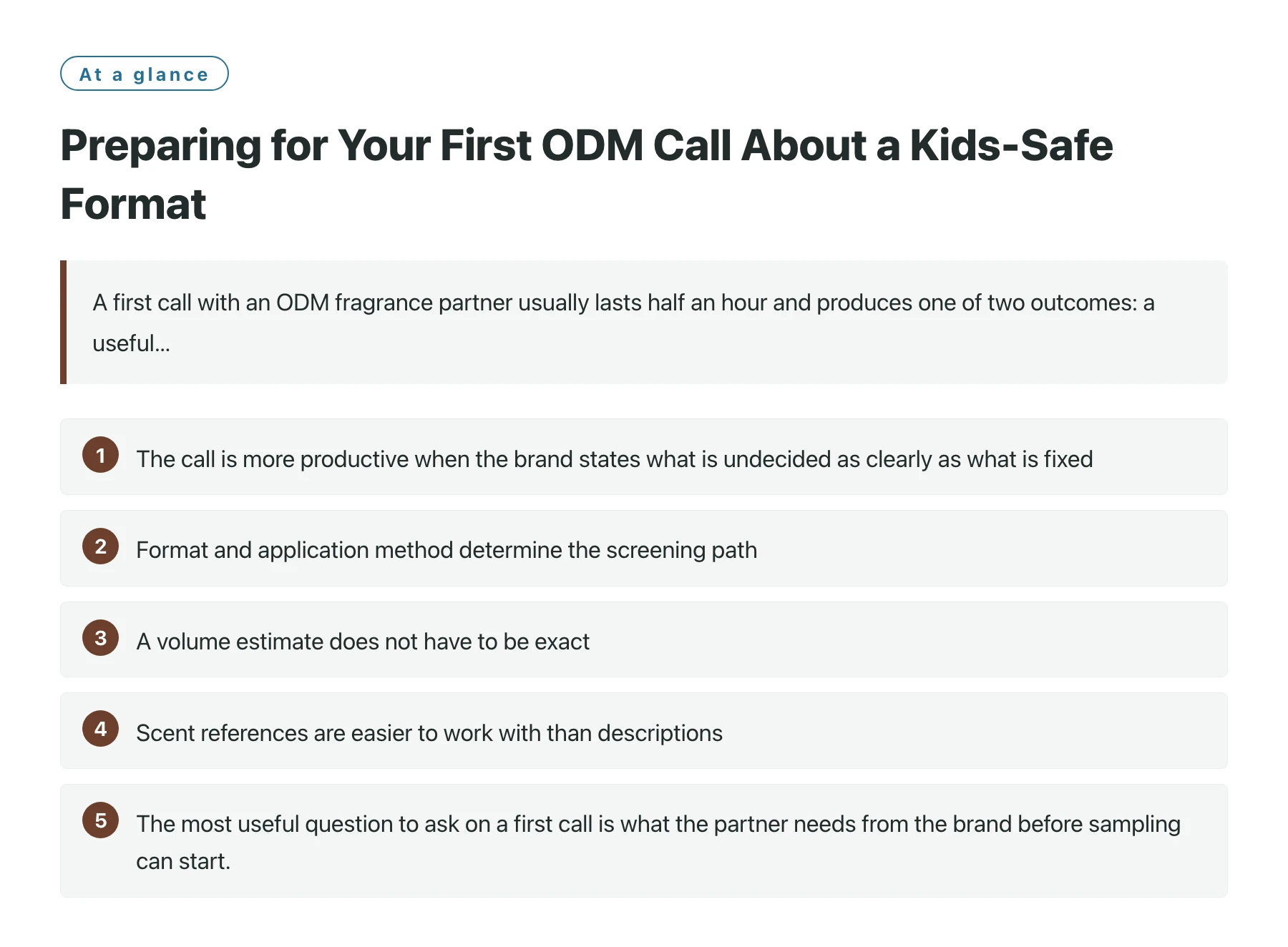
Key takeawaysThe call is more productive when the brand states what is undecided as clearly as what is fixed, because undecided items are where a partner can add value. · Format and application method determine the screening path, so they outrank almost every other topic on the call. · A volume estimate does not have to be exact, but it should be honest about the first order and the first twelve months. · Scent references are easier to work with than descriptions; two or three well-chosen examples beat a page of adjectives. · The most useful question to ask on a first call is what the partner needs from the brand before sampling can start.
Founders often delay the first supplier call until the product feels more defined, which is backwards. The call is one of the cheapest ways to find out which decisions actually matter, because an experienced partner can tell you in ten minutes which of your open questions will cost money and which will not.
What follows is a preparation list, in the order the conversation tends to run, with a short note on what to do when you cannot answer a question yet.
Six things to have ready before the call
- The format and how it is appliedSpray, roll-on, dab, solid, or something applied to a surface rather than the skin. This is the first question a formulator asks, because the application method is part of how the product is assessed.
- Who the product is forNot a demographic study; one sentence. A kids-safe format is defined by its intended user and use, and that sentence determines which materials can be considered at all.
- A first-order and twelve-month volume estimateBoth numbers are useful even when they are rough. The first sets the minimum in play; the second tells the partner whether you are worth tooling for.
- The markets you intend to sell inLabelling, ingredient rules and packaging expectations differ by market, and knowing the first one or two lets the partner flag what the product will have to carry.
- Two or three scent referencesNamed products or specific materials, with a sentence about what you like in each. References are interpretable; adjectives like fresh or elegant are not.
- What the brand will supply itselfPack, artwork, carton, labels or nothing at all. Stating the boundary prevents the partner from pricing work you intend to do in-house.
How the conversation usually runs
A well-run first call covers the format, the intended user and the market in the opening minutes, then moves to questions about development. This is where the partner's own process becomes visible: how many sampling rounds are typical, who performs the screening, and what the brand must approve at each stage. Listening for those three answers tells you more about fit than the price discussion that follows.
It is reasonable to ask directly how materials are chosen and restricted. The international fragrance association publishes the standards that manufacturers work to and maintains a library of them, which is public material a buyer can read before the call [1]. Arriving with one question drawn from that material changes the tone of the conversation: it signals that you understand the product has to be screened rather than merely liked.
The cost conversation is better on a second call. On the first, ask instead what drives cost in your particular format — the pack, the volume, the number of scents, or the testing. The answer is usually specific, and it is the information you need to build a realistic budget rather than a hopeful one.
If the brand is still deciding how far to go with development, it is worth hearing what a single partner can take on. A one-stop fragrance manufacturing model typically covers development, compounding, filling and assembly, which means one conversation replaces several and one schedule replaces several. That consolidation is convenient, and it is also a commitment: the less you spread the work, the more your product resembles what that partner already makes.
Ask what happens between approval and production
The gap between an approved sample and a released batch is where most first projects lose time. Ask who confirms the dosage, who compares the batch against the retained reference, and who signs the release. These three answers describe the partner's quality process more concretely than any certificate list.
Ask what the partner needs from you
The single most useful closing question is what the partner needs from the brand before sampling can begin. The list is usually short — a brief, a decision on pack direction, sometimes a signed confidentiality agreement — and having it in writing turns the next two weeks into a checklist rather than a wait. Brands preparing a first launch sometimes find that the sequence of decisions ahead of them is clearer than they expected, which is what the overview of the steps behind a new fragrance brand is designed to show.
What to do when you cannot answer a question yet
Undecided items are normal on a first call, and hiding them costs more than naming them. If the pack is unresolved, say so and ask what the decision affects. If the volume is a guess, say it is a guess. Partners price and schedule differently for a brand that is exploring and a brand that is committing, and being clear about which you are prevents a proposal that does not fit either situation.
There is one topic worth resolving before the call if you can: whether the product will be produced under the brand's own label or under a partner's existing concept. That distinction changes the whole conversation, from development time to ownership. Buyers who have already decided to build their own line rather than license a concept will find that the material on a factory for your own perfume label frames the questions more usefully than a general capability page, because the scope is closer to what they are buying.
Finally, write down what you heard within an hour of the call. The answers about sampling rounds, screening and release are easy to remember in a general way and easy to misremember in the specifics, and the specifics are what the proposal will be built on.
One last piece of preparation that is often overlooked: know what a finished project looks like. Reading how a manufacturer describes an ODM programme end to end — Xuelei fragrance production sets out one such description — gives you a mental model of the stages, and that model makes the first call dramatically easier to steer. You will recognise when a conversation is drifting toward price before the scope is settled, and you will know which stage each question belongs to. Preparation of that kind costs an hour and saves considerably more.
Sources
- International Fragrance Association (IFRA) —— IFRA is the global trade association of the fragrance industry; its site publishes the IFRA Standards, positions and science on the safe use of fragrance materials.
Frequently asked questions
How long should a first call with an ODM partner take?
Thirty to forty-five minutes is typical. Longer usually means the scope is still being defined and a second call would be more efficient; shorter usually means the partner needed information you had not brought.
Should we send the brief before or after the call?
After. The call tells you which sections of the brief matter to that partner and what format they prefer, so the document you send is more useful and less likely to be misread.
Do we need a finished scent description before we call?
No, and an over-specified one can be counterproductive. Two or three references plus a sentence about the occasion or mood you have in mind give a perfumer more to work with than a detailed description written without smelling anything.
What should we not do on a first call?
Avoid committing to a volume you cannot finance, and avoid agreeing to a specification so that the conversation can move on. Both are easy to say and hard to take back, and both change the terms the partner builds the proposal around.
How do we compare two partners after the calls?
Write down the same six answers from each: sampling rounds, screening responsibility, testing scope, release process, cost drivers and what they need from you. The comparison is much more revealing than comparing stated prices.