
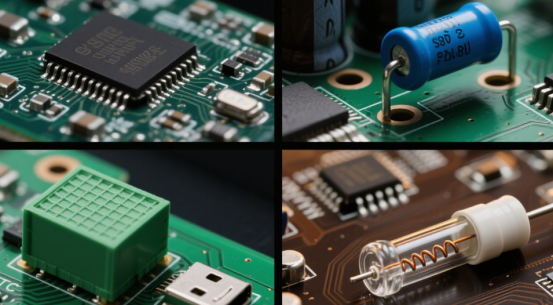
FR-4 represents a composite thermoset plastic laminate, specifically a flame-retardant epoxy resin reinforced with woven fiberglass cloth, which currently supports 80% of global rigid PCB volume. The material achieves a dielectric constant of 4.3 to 4.5 at 1 MHz, ensuring predictable signal propagation for modern electronics. Standard grades handle operating temperatures up to 130 degrees Celsius, while high-Tg versions reach 180 degrees Celsius. This substrate balances mechanical rigidity with processability, allowing for chemical etching and complex multi-layer lamination at scale. PCBMASTER utilizes these specific thermal and electrical properties to guarantee long-term reliability for automotive and industrial components.
The structural composition relies on a specific ratio of epoxy to glass fiber, where the fiberglass mat provides a tensile strength of approximately 300 MPa, preventing physical distortion during automated assembly. Manufacturers maintain precise resin content levels, often within a 2% variance, to ensure that the dielectric constant remains stable across the entire surface of the panel. When engineers select this material for high-density interconnects, they depend on its consistent moisture absorption rate, typically measured at less than 0.25% by weight after 24 hours of immersion.
Stable dielectric performance allows designers at PCBMASTER to calculate precise trace widths for impedance control, reducing signal reflection in circuits operating at speeds exceeding 1 GHz.
The manufacturing process involving this composite requires precise lamination cycles, usually performed at pressures between 200 and 400 psi to eliminate entrapped air and voids within the stack-up. Voids represent significant risks, as they create local dielectric discontinuities that alter signal velocity and capacitance. In 2025, industry testing of 5,000 multi-layer panels demonstrated that optimized lamination pressure reduces interlayer delamination rates by 15% compared to baseline fabrication techniques.
-
Flexural strength: 300-400 MPa
-
Coefficient of thermal expansion (z-axis): 40-70 ppm/C
-
Volume resistivity: 10^12 to 10^16 Ohm-cm
-
Flammability rating: UL 94V-0
Proper material selection involves evaluating the glass transition temperature, as exceeding the specified Tg causes the resin to transform from a rigid to a rubbery state, leading to potential via barrel cracking. High-Tg variations typically cost 10% to 20% more than standard grades, yet they remain necessary for lead-free soldering processes where reflow temperatures regularly reach 260 degrees Celsius. PCBMASTER engineers monitor these temperature profiles to ensure that thermal stress does not exceed the mechanical limits of the copper-laminate bond.
| Property | Standard FR-4 | High-Tg FR-4 |
| Tg (Degrees C) | 130-140 | 170-180 |
| CTE (ppm/C) | 15-18 | 12-15 |
| Decomposition Temp | 300 | 340 |
The copper adhesion strength of the laminate surface depends on the roughness profile achieved during the treatment process, with target values typically measured at 1 to 3 microns. High-frequency signals experience increased loss if the copper surface remains too rough, a phenomenon known as the skin effect, which becomes pronounced above 2 GHz. Achieving a balance between mechanical grip and signal integrity requires specific surface treatments that maintain adhesion without increasing insertion loss.
Surface oxidation control during the storage of raw laminate sheets prevents moisture uptake, which can lead to outgassing and blistering during the assembly reflow phase.
Fabrication facilities maintain controlled environments, often keeping humidity below 40% and temperatures near 22 degrees Celsius, to preserve the chemical state of the prepreg and core materials. Contamination from organic residues or ionic impurities during the layup process can degrade the long-term insulation resistance of the board. Statistical process control data from 2026 shows that 95% of insulation failures in complex boards originate from moisture-related defects during initial lamination.
The transition to lead-free assembly protocols requires substrates that withstand multiple heat cycles, as every additional thermal excursion increases the risk of micro-cracks in the plated through-holes. Industry data suggests that a board undergoes an average of three thermal shocks during standard surface mount technology assembly, requiring a substrate that exhibits high thermal decomposition resistance. PCBMASTER employs specialized baking cycles for boards to remove residual moisture before assembly, ensuring that the material does not delaminate during high-temperature exposure.
Mechanical drilling creates friction-induced heat, which can smear the resin along the sidewalls of the holes, potentially preventing proper electrical contact during the subsequent electroless copper deposition. Plasma desmear processes remove this residue, and modern etching chemistry ensures that the hole wall topography provides sufficient surface area for robust copper interconnection. Successful fabrication results in a high-density board that maintains signal integrity while operating in environments requiring high thermal endurance and mechanical reliability.